
The real difference between organic and chemical fertilizers — and what it means for your farm, your soil, and your income
The Fertilizer That Worked — Until It Didn’t
Joseph has grown maize on his three-acre farm in western Uganda for over fifteen years. For the first decade, chemical fertilisers delivered reliable results — good yields, predictable growth, straightforward application. However, over the last few seasons, something has shifted. He is applying the same amount of fertiliser as before, yet his yields are declining. His soil is becoming harder to work after rain. Costs keep rising while margins stay flat.
Joseph’s situation is not unusual. In fact, it reflects a pattern that researchers across Sub-Saharan Africa have documented repeatedly: long-term reliance on chemical fertilisers alone tends to degrade the very soil that crops depend on, leading to a cycle of diminishing returns that traps farmers into spending more for less.
Understanding why this happens — and what the alternative looks like — is the purpose of this guide. By the end, you will have a clear picture of what organic fertilisers actually do that chemical ones cannot, why the science strongly supports making the switch, and how to apply this knowledge practically on your own farm.
What Is the Actual Difference Between Organic and Chemical Fertilizers?
Before comparing them, it helps to understand what each type is and how each one works.
Chemical (Synthetic) Fertilizers
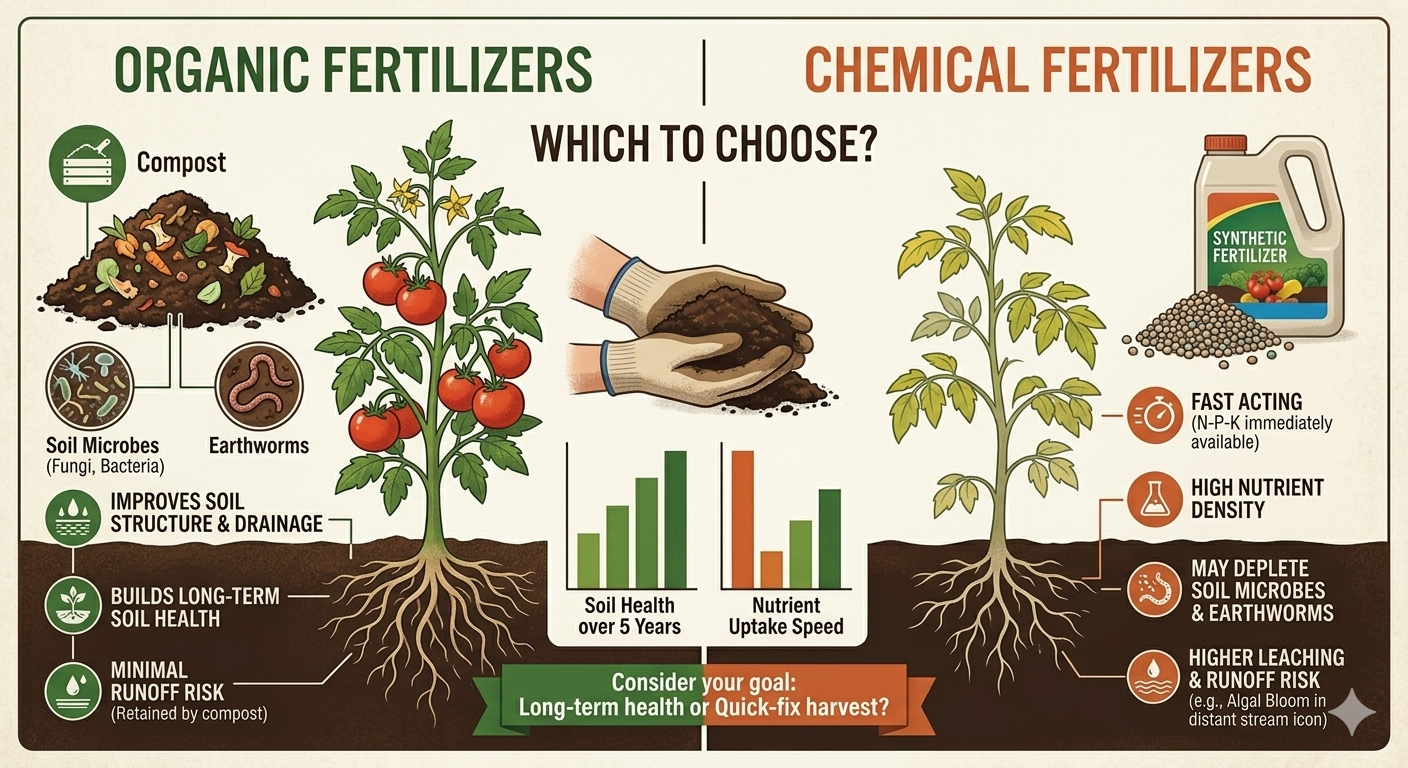
Chemical fertilisers are manufactured products that deliver concentrated, immediately available nutrients — most commonly nitrogen (N), phosphorus (P), and potassium (K) — directly to the plant. They work quickly, which is why they became so widely adopted. However, they feed the crop without feeding the soil. Consequently, the complex ecosystem of bacteria, fungi, earthworms, and other organisms that make soil productive is left without nourishment — and over time, it declines.
Organic Fertilizers
Organic fertilisers — including compost, manure, green manures, and natural mineral products like Epso Microtop and Organic Vegetable Plant Food — release nutrients more gradually as they break down. As a result, they feed the soil biology at the same time as they feed the crop. This dual action is what makes organic fertilisers fundamentally different: they improve the growing environment with every application, rather than simply delivering a short-term nutrient hit.
Organic vs. Chemical Fertilizers: A Side-by-Side Comparison
| Factor | Chemical Fertilizers | Organic Fertilizers |
| Nutrient release | Immediate — fast uptake | Gradual — sustained over weeks |
| Effect on soil biology | Reduces microbial diversity over time | Increases microbial biomass and diversity |
| Effect on soil organic carbon | Neutral to negative long-term | Increases by 18–25% in Sub-Saharan African soils (Smith et al., 2015) |
| Soil pH over time | Often acidifying with repeated use | Buffers against acidification |
| Water retention | No improvement; can worsen with soil degradation | Improves significantly as organic matter builds |
| Input cost trend | Rising as soil requires more to achieve same yield | Falling as on-farm fertility builds over seasons |
| Environmental risk | Leaching into waterways; nutrient runoff | Minimal leaching; builds soil carbon |
| Long-term yield trend | Declining on degraded soils without organic matter | Stable to increasing as soil health improves |
| Market access | Standard commodity prices | Premium organic market access possible |
Reason 1: Organic Fertilizers Build Soil That Gets Better Every Season
The most important difference between organic and chemical fertilisers is what happens to your soil over time. Research published in Frontiers in Microbiology confirms that the use of organic fertilisers in Sub-Saharan Africa increases soil organic carbon by 18–25% and significantly enhances microbial biomass — the living engine that drives nutrient cycling, disease suppression, and water retention in healthy soil.
In contrast, long-term chemical fertilisation has been shown to reduce soil microbial diversity and acidify soil pH — the exact conditions that make soil less productive and more expensive to maintain. Furthermore, research from a 40-year fertilisation experiment found that organic fertilisation improved topsoil total nitrogen by 66.7–122%, total phosphorus by 198.6–413%, and available potassium by 35.3–438% compared to chemical-only treatments.
In other words, organic fertilisers are not just a substitute for chemical ones — they are an investment that compounds in value with each passing season.
| Research FindingA 23-year panel study across Sub-Saharan Africa found that organic fertiliser use has a significant positive effect on cereal yields in both the short and long run, with productivity gains coming from intensifying existing land rather than expanding cultivation area. (Springer Nature, 2026) |
Reason 2: Organic Fertilizers Make Your Other Inputs Work Harder
One of the most practically important findings from fertiliser research is that organic and chemical fertilisers work better together than either does alone. However, for organic farmers, this insight points to something even more useful: when your soil organic matter is high, the nutrients already in your soil become more available to your crops without additional purchased inputs.
Specifically, research shows that organic acids and amino acids generated during the decomposition of organic matter actively release potassium, phosphorus, and other nutrients that are bound up in the soil — nutrients that chemical-only farmers are effectively leaving unused. Additionally, sulphur — one of the key nutrients in natural mineral fertilisers like Epso Microtop — increases nitrogen use efficiency, meaning the nitrogen already present in your soil delivers more benefit when sulphur levels are adequate.
The practical result is that a well-managed organic fertility programme often delivers comparable yields to a chemical programme at a lower purchased input cost, because the soil itself is doing more of the nutritional work.
Reason 3: The True Cost of Chemical Fertilizers Is Higher Than It Appears
The upfront cost comparison between organic and chemical fertilisers often appears to favour chemical products. Nevertheless, this comparison misses the full picture of what chemical fertilisation costs over time.
Rising Quantities Required
As soil organic matter declines under chemical-only management, the soil’s ability to retain and cycle nutrients deteriorates. Consequently, farmers must apply increasing quantities of chemical fertiliser just to maintain the same yield — a pattern that drives input costs steadily upward while returns stay flat. Joseph’s experience at the start of this guide reflects exactly this dynamic.
Soil Acidification Costs
Research in Kenya found that mineral fertiliser use was negatively associated with soil potassium and pH. As soils acidify, farmers must also invest in lime to correct pH — an additional cost that organic management typically avoids, since organic matter naturally buffers soil against acidification.
Market Opportunity Cost
Perhaps most importantly for commercial farmers, chemical-only production locks you out of the premium organic market. Supermarkets, hotels, and export buyers across Sub-Saharan Africa consistently pay 30–70% above conventional prices for certified organic produce. That price differential is a direct cost of not going organic.
| Important Note on Input CostsPOFI positions organic fertilisers as supplements to NPK fertilisers — not as complete replacements in all situations. The research shows that the combination of organic and mineral inputs typically outperforms either alone. However, the organic component is what builds long-term soil health and reduces your dependence on purchased mineral inputs over time. |
Reason 4: Organic Fertilizers Protect Your Soil’s Water-Holding Capacity
Across Sub-Saharan Africa, where rainfall is increasingly unpredictable and dry seasons are lengthening, a crop’s ability to access soil moisture during dry periods is one of the most important determinants of yield. Organic matter is the key variable that controls how well soil holds water.
Research consistently shows that soils with higher organic matter content retain significantly more moisture between rains, making crops more resilient during dry spells. Moreover, organic matter improves soil structure — creating the aggregates and pore spaces that allow water to infiltrate quickly during heavy rain rather than running off, taking topsoil with it.
Chemical fertilisers contribute nothing to soil organic matter. In contrast, each application of compost, manure, or organic plant food adds to the organic matter bank that determines how your soil performs in the next drought.
Reason 5: Organic Fertilizers Are Safer for Farmers, Families, and Communities
The health risks of repeated synthetic fertiliser and pesticide exposure are well documented. Nitrogen-based chemical fertilisers contribute to nitrate leaching into groundwater — a serious concern in areas where communities rely on wells and boreholes for drinking water. Furthermore, the manufacturing and transport of synthetic fertilisers generates significant greenhouse gas emissions, contributing to the climate variability that Sub-Saharan African farmers are already experiencing.
Organic fertilisers, by contrast, are derived from natural sources — plant waste, animal manure, and natural mineral deposits. They do not leach harmful compounds into groundwater and they contribute positively to soil carbon stocks, helping to mitigate rather than accelerate climate change. For a farmer who is simultaneously trying to grow food and protect the environment their family depends on, this distinction matters.
What POFI Recommends: Building Your Organic Fertility Programme
Building a productive organic fertility programme does not require eliminating all mineral inputs overnight. Instead, it means deliberately shifting the balance toward organic inputs over successive seasons as your soil health improves. Here is a practical approach:
- Start with compost and manure: These are the foundation of any organic fertility programme. Even a modest application of well-made compost at planting significantly improves soil biological activity and water retention from the first season.
- Add targeted organic plant food: Products like Organic Vegetable Plant Food and Green Boots Vegetables and Herbs Plant Food provide balanced nutrition specifically formulated for vegetable crops, without synthetic chemicals.
- Use micronutrient support: Supplement with natural mineral foliar fertilisers like Epso Microtop to correct magnesium, sulphur, boron, and manganese deficiencies that soil-applied fertilisers often miss — especially in acidic or sandy Sub-Saharan African soils.
- Rotate crops deliberately: Include legumes (beans, groundnuts, cowpeas) in your rotation to naturally fix nitrogen from the atmosphere into your soil — a free nitrogen input that reduces your dependence on purchased fertilisers.
- Monitor your soil: Soil tests every one to two seasons help you understand exactly what your soil needs, so you can target your inputs precisely rather than applying broad-spectrum fertilisers by habit.
| Build Your Organic Fertility Programme with POFIPure Organic Farming Inputs (POFI) stocks a range of certified organic fertilisers and plant foods suited to vegetable, fruit, and field crop production across Sub-Saharan Africa: Organic Vegetable Plant Food, Green Boots Vegetables and Herbs Plant Food, and Epso Microtop natural micronutrient fertiliser. All products ship worldwide from the Netherlands. Visit pureorganicfarminginputs.com for more information or to place your order. |
Frequently Asked Questions
Will organic fertilizers give me the same yield as chemical ones?
In the short term, there may be a transitional period of one to two seasons while your soil biology rebuilds. However, research across Sub-Saharan Africa consistently shows that well-managed organic programmes achieve comparable yields to chemical programmes within two to three seasons — and often exceed them over the longer term as soil health continues to improve.
Are organic fertilizers more expensive than chemical ones?
The upfront cost per kilogram of some organic inputs can be higher than chemical equivalents. Nevertheless, the total cost picture is different: organic management typically reduces the quantity of purchased inputs needed over time as soil fertility builds, while chemical-only programmes often require escalating inputs to maintain the same yields. Over multiple seasons, organic programmes are frequently cheaper overall.
Can I use organic and chemical fertilizers together?
Yes — and research shows that combining organic and mineral inputs frequently delivers better results than either alone, particularly on degraded soils. POFI positions organic fertilisers as supplements to your existing programme, not immediate full replacements. The goal is to gradually increase the organic proportion of your fertility programme as your soil health improves.
What is the best organic fertilizer for vegetable crops in Sub-Saharan Africa?
A combination approach works best: well-made compost or manure as the foundation, supplemented by Organic Vegetable Plant Food for balanced crop nutrition and Epso Microtop for micronutrient support during flowering and fruit development. Read our full Epso Microtop guide for detailed application timing.
How long does it take to see results from switching to organic fertilizers?
Many farmers see visible improvements in soil structure and water retention within the first season of organic management. Yield improvements typically become clear within two to three seasons as the soil biological community rebuilds and organic matter levels rise. The longer you farm organically, the stronger the compounding benefit becomes.
Continue reading: What Is Organic Farming? A Simple Guide for Beginners — Epso Microtop: What It Is and How to Use It on Your Farm — How to Grow Organic Cucumbers in Sub-Saharan Africa
References
1. Smith, P. et al. (2015). Organic fertilizer use in South Asia and Sub-Saharan Africa: effects on soil organic carbon and microbial biomass. Referenced in Frontiers in Microbiology (2025).
2. Springer Nature Link (2026). Organic fertilizer utilization and food production dynamics in Sub-Saharan Africa. Environment, Development and Sustainability.
3. Nature npj Sustainable Agriculture (2026). Fertilizer and soil health for sustained crop production in sub-Saharan Africa.
4. NCBI / PubMed (2023). Long-Term Organic Fertilization Enhances Soil Fertility and Reshapes Microbial Community Structure.
5. ResearchGate (2019). Influence of Long-term Chemical Fertilizers and Organic Manures on Soil Fertility — A Review.