
Introduction: Why Tomatoes Matter — and Why Simona F1 Stands Out
The tomato is one of the most important crops across Sub-Saharan Africa. To a farmer it is green gold; to a merchant it is daily income; to a chef it is the glue that holds every dish together. From the rolex stalls of Kampala to the jollof pots of Lagos, the tomato is irreplaceable.
But not every tomato seed is created equal. As commercial farming grows across Uganda, Kenya, Tanzania, Zambia, Nigeria, Ghana, and the wider region, the demand for high-yield, disease-resistant hybrid seeds has never been higher — and that is exactly where Simona F1 tomato seeds lead the market.
What Is Simona F1 Tomato? (F1 Hybrid Explained)
If you have been asking, “What is Simona F1 tomato?” — here is a clear answer.
The F1 in Simona F1 stands for First Filial Generation. It refers to the first-generation offspring produced by crossing two carefully selected, genetically pure parent tomato lines. When you cross Parent Line A with Parent Line B, the result is an F1 hybrid — a plant that inherits the best traits of both parents.
Think of it as breeding two champion parent lines to produce offspring with superior performance. The exact parent lines used by the breeder are kept proprietary, but the results are well documented: Simona F1 was developed by crossing one parent line bred for high yield and superior fruit quality with another bred for strong disease resistance and vigorous growth.
Simona F1 Tomato Key Traits and Specifications
Plant Type: Indeterminate (requires staking or trellising) — vigorous, tall-growing plant.
Maturity: Medium maturity — ideal for planning consistent market supply.
Fruit Characteristics
- Weight: 160 – 200 grams per fruit
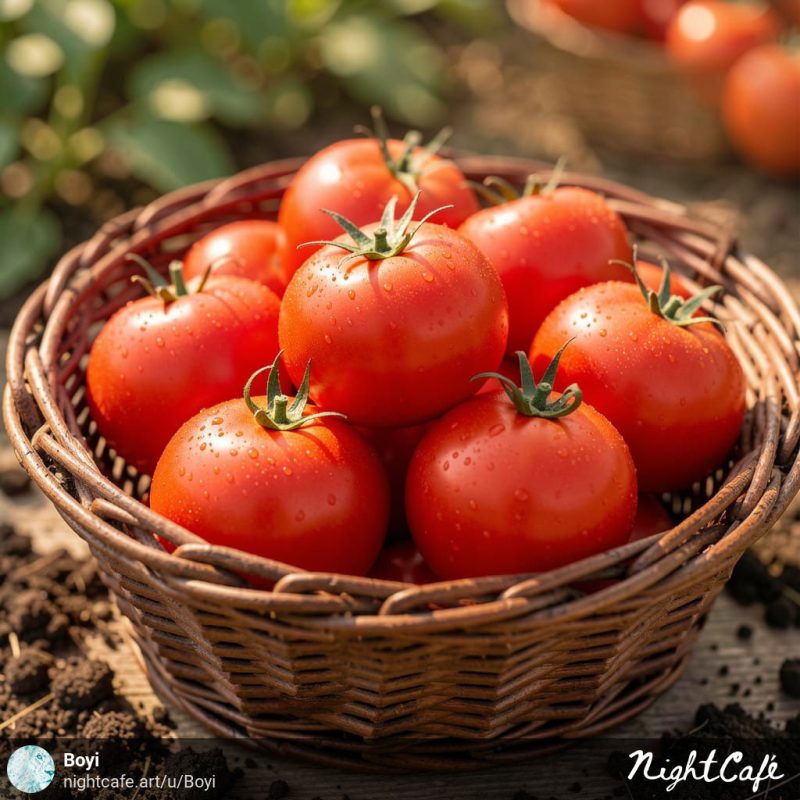
- Shape: Flattened globe — attractive and market-preferred
- Colour: Deep red with slight green shoulders before peak ripeness
- Firmness: Excellent — withstands transportation without bruising
- Taste: Juicy and full-flavoured — strong consumer appeal
- Shelf Life: Superior — stays fresh longer post-harvest
Yield and Production
Simona F1 is a high-yielding hybrid. Under proper agronomic management — correct spacing, timely irrigation, and balanced fertilisation — farmers achieve a high number of boxes per plant, making it one of the most profitable tomato varieties available across Sub-Saharan Africa today.
Simona F1 Disease Resistance: The Farmer’s Biggest Advantage
One of the top reasons commercial farmers across Sub-Saharan Africa choose Simona F1 is its impressive disease resistance and tolerance profile. Reducing crop losses means reducing costs and increasing profit margins.
Simona F1 shows documented resistance or tolerance to:
- Fusarium Wilt — a devastating soil-borne fungal disease
- Verticillium Wilt — another damaging fungal pathogen
- Tobacco Mosaic Virus (ToMV) — a common viral threat in tomato fields
- Nematodes (Root-Knot) — soil pests that reduce root function and yield
- Myzus persicae (Green Peach Aphid) — a major pest and virus vector
This broad resistance profile means lower spending on fungicides and pesticides, giving Simona F1 farmers a clear cost advantage over farmers growing susceptible varieties.
Why Farmers Across Sub-Saharan Africa Should Choose Simona F1 Tomato Seeds
Whether you are a commercial farmer, a smallholder scaling up, or a greenhouse producer, here is why Simona F1 belongs in your next season’s plan:
- High Yields: More tomatoes per plant — more boxes to sell, more income per acre.
- Disease Resistance: Reduces costly chemical inputs and crop failure risk.
- Uniform, Market-Ready Fruits: Consistent size and shape preferred by supermarkets, exporters, and traders.
- Excellent Firmness: Survives long-distance transport from farm to market without damage.
- Long Shelf Life: Stays fresh longer, reducing post-harvest losses.
- Fast, Vigorous Growth: Strong plants from the start — less nursery failure.
- Better Profit Margins: More marketable fruits + lower input costs = improved returns.
Consideration: As with all F1 hybrids, seeds must be purchased fresh each season. Saved seeds from harvested fruits will not reproduce the same quality, yield, or disease resistance consistently.
How to Buy Genuine Simona F1 Tomato Seeds in Sub-Saharan Africa
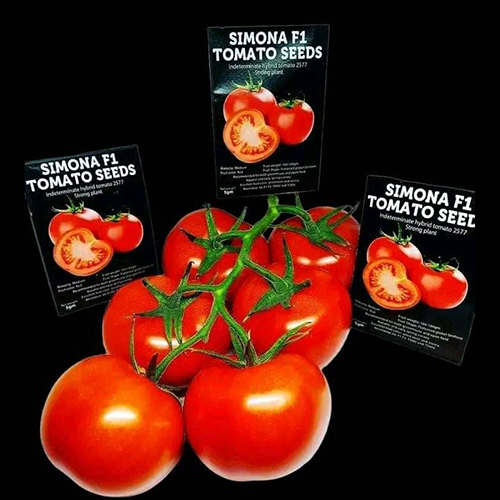
Counterfeit seeds are a serious problem across Sub-Saharan Africa. Buying fake or poor-quality seeds wastes your money and risks your entire season. Here is how to protect yourself:
When Buying Simona F1 Seeds
- Buy from registered, trusted suppliers: Source your seeds from verified agricultural input dealers. We recommend Pure Organic Farming Inputs (POFI) — a trusted, registered seed supplier serving farmers across Sub-Saharan Africa. Contact POFI directly via their Facebook page, webiste or official email.
- Check the packaging: Always look for clearly branded, sealed packaging with the Simona F1 label. Avoid plain, unbranded, or loosely packaged seeds — these are common signs of counterfeit products.
- Ask for documentation: Reputable suppliers can provide seed batch details and product information sheets.
When Buying Simona F1 Fresh Fruit (Retailers and Traders)
- Fruit Shape: Genuine Simona F1 fruits are flattened globe-shaped and feel heavy for their size — typically 160 to 200 grams.
- Colour: Look for a deep, glossy, uniform red exterior. A slight green shoulder near the stem is normal and natural for Simona F1.
- Firmness: Squeeze gently — it should feel solid and meaty with a thick skin. Avoid soft, hollow, or cracked fruits.
Simona F1 Tomato: Pros and Cons
Pros
- High yield per plant — maximises income per acre
- Broad disease resistance — cuts input costs significantly
- Uniform, attractive fruits — preferred by buyers and supermarkets
- Excellent firmness — suitable for long-distance transport
- Long shelf life — fewer post-harvest losses
- Fast, vigorous growth — reduces nursery failure
- Strong market demand — easy to sell at premium prices
Cons
- F1 hybrid — new seeds must be purchased every season
- Saved seeds will not produce consistent quality or yields
- Indeterminate growth requires staking investment
Conclusion: Is Simona F1 the Right Tomato Seed for You?
If you are a serious farmer in Sub-Saharan Africa looking for a tomato seed that delivers high yields, disease resistance, and market-ready fruits, Simona F1 is one of the strongest choices available today.
Its proven resistance to Fusarium wilt, Verticillium wilt, nematodes, and Tobacco Mosaic Virus means you spend less managing crop disease and more time managing your harvest. Combined with firm, uniform, great-tasting fruits that hold up in transport and storage, Simona F1 ticks every box for commercial tomato production across the region — from Uganda and Kenya to Nigeria, Ghana, Zambia, and beyond.
Ready to get started? Purchase your genuine Simona F1 tomato seeds from Pure Organic Farming Inputs (POFI) — a trusted agricultural input supplier serving farmers across Sub-Saharan Africa. Contact them on Facebook or website to place your order today.
Frequently Asked Questions About Simona F1 Tomato Seeds
What does F1 mean in Simona F1 tomatoes?
F1 stands for First Filial Generation. It means the seed is produced by crossing two pure parent tomato lines. F1 hybrids are valued for their vigour, uniformity, high yield, and disease resistance.
How many days does Simona F1 take to mature?
Simona F1 has a medium maturity cycle. Exact days to harvest vary based on climate, altitude, and management practices in your specific location across Sub-Saharan Africa.
Where can I buy Simona F1 seeds in Sub-Saharan Africa?
You can purchase genuine Simona F1 seeds from registered seed suppliers such as Pure Organic Farming Inputs (POFI), who serve farmers across the region including Uganda, Kenya, Tanzania, Rwanda, DRC, Zambia, Malawi, Zimbabwe, Botswana, Namibia, Somalia, Guinea-Conakry, Ghana, and Nigeria. Always buy from trusted, registered dealers to avoid counterfeit seeds.
Can I save Simona F1 seeds for the next season?
No. As an F1 hybrid, saved seeds will not reliably reproduce the same yield, disease resistance, or fruit quality. For consistent results, buy fresh certified seeds every planting season.
What diseases is Simona F1 resistant to?
Simona F1 shows resistance or tolerance to Fusarium wilt, Verticillium wilt, Tobacco Mosaic Virus, nematodes, and Myzus persicae (green peach aphid).
References
1. Hazera Genetics. Simona F1 Tomato — Variety Data Sheet. Hazera Seeds. Available at: www.hazera.com [Accessed May 2025].
2. Food and Agriculture Organization of the United Nations (FAO). Hybrid Seed Production in Vegetables. FAO Plant Production and Protection Paper No. 110. Rome: FAO. Available at: www.fao.org/publications [Accessed May 2025].
3. International Tomato Genome Sequencing Consortium. (2012). The tomato genome sequence provides insights into fleshy fruit evolution. Nature, 485, 635–641. Available at: https://doi.org/10.1038/nature11119
4. National Agricultural Research Organisation (NARO) Uganda. Tomato Production Guide for Uganda. Kampala: NARO. Available at: www.naro.go.ug [Accessed May 2025].
5. Ministerio de Agricultura, Pesca y Alimentación (MAPA) / EPPO Global Database. Verticillium dahliae and Fusarium oxysporum — Pathogen Data Sheets. European and Mediterranean Plant Protection Organization. Available at: gd.eppo.int [Accessed May 2025].
6. Muthoni, J., Shimelis, H. & Melis, R. (2010). Tomato production in Uganda: constraints and opportunities for improved cultivar development. African Journal of Agricultural Research, 5(21), 2935–2945.
7. Pure Organic Farming Inputs (POFI). Simona F1 Seeds — Product Listing. Kampala, Uganda. Contact via Facebook: facebook.com/POFIUganda [Accessed May 2025].
8. Foolad, M.R. (2007). Genome mapping and molecular breeding of tomato. International Journal of Plant Genomics, 2007, Article ID 64358. Available at: https://doi.org/10.1155/2007/64358
Note: All web references were verified as accessible at the time of writing. URLs may change; readers are advised to search for the source title directly if a link becomes unavailable.