
How to Identify and Manage Them Organically — Part 2 of 3
From Growing to Protecting: Why This Guide Exists
In Part 1 of this series, we walked through everything you need to get a healthy organic cucumber crop in the ground — soil preparation, seed selection, spacing, watering, and feeding. Now comes the part that separates a good harvest from a failed one: protecting what you have grown.
Disease and pests are the single biggest threat to cucumber yields across the Sub Sahara. Farmers can lose between 30% and 100% of a cucumber crop in a single season if problems go undetected or unmanaged. The good news: most of these threats are preventable, and every one of them can be managed organically if you catch them early.
This guide gives you the essentials — fast identification, the key symptoms to look for, and the most effective organic fix for each threat. Keep it handy and refer to it every time you scout your field.
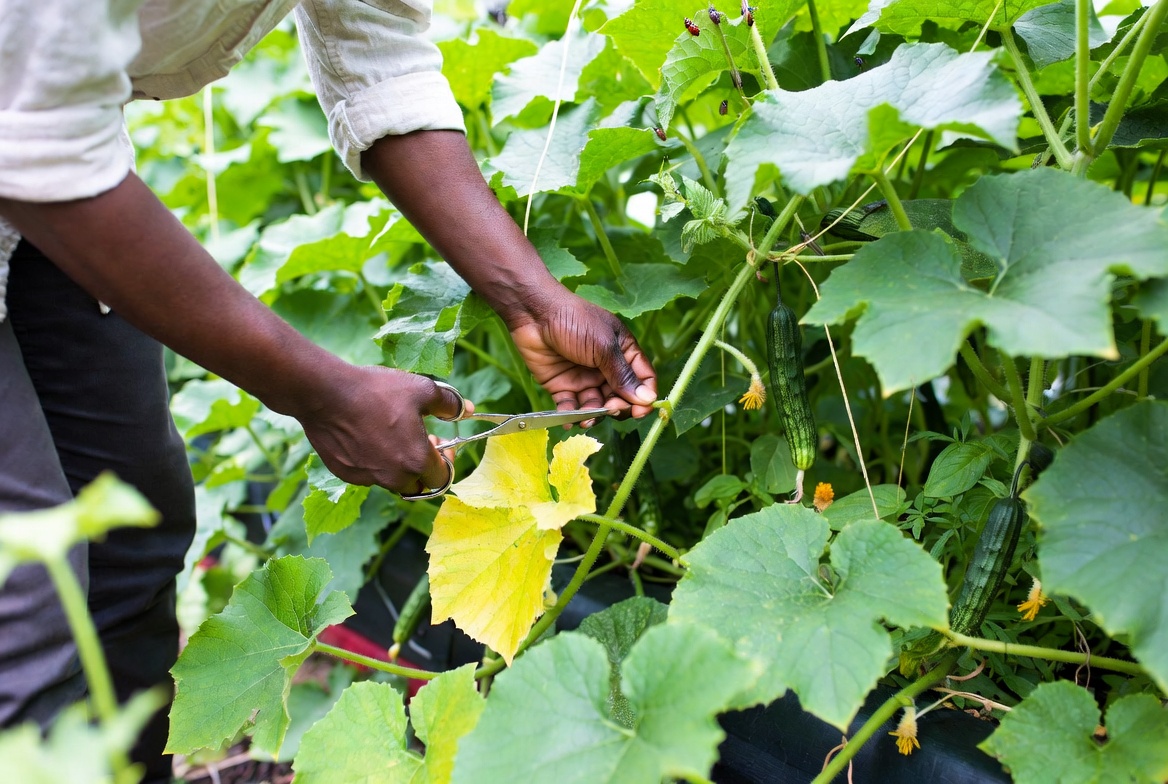
| The One Rule That Matters Most Scout your cucumber field every 2–3 days. Walk every row. Check both sides of leaves, stems, and fruit. Most disease and pest problems cost 10 times more to fix at 50% infection than at 5%. The farmers who catch problems early spend less and harvest more — every time. |
Spot the Problem Fast: Quick Identification Table
Something look wrong in your field? Find the symptom in the table below and jump straight to the right section.
| What You See | Likely Cause | Go To |
| Angular yellow spots on upper leaves; grey-purple fuzz underneath | Downy Mildew | Disease Section 1 |
| White powdery coating on upper surface of older leaves | Powdery Mildew | Disease Section 2 |
| Whole plant wilts suddenly; milky ooze from cut stem | Bacterial Wilt | Disease Section 3 |
| Yellow mosaic mottling on young leaves; distorted, stunted growth | Cucumber Mosaic Virus | Disease Section 4 |
| Soft-bodied insects on leaf undersides; sticky residue; curling leaves | Aphids | Pest Section 1 |
| Tiny white insects fly up when leaves disturbed; sooty mould on leaves | Whitefly | Pest Section 2 |
| Fine webbing on leaf undersides; bronze/yellow speckling | Spider Mites | Pest Section 3 |
| Puncture marks on fruit skin; maggots inside; premature fruit drop | Fruit Fly | Pest Section 4 |
The Diseases: What to Look For and What to Do
Disease 1: Downy Mildew — The Rainy Season Enemy
Downy mildew (Pseudoperonospora cubensis) is the most explosive cucumber disease in Sub-Saharan Africa. In cool, wet, humid conditions — typical of highland rainy seasons in Uganda, Kenya, and Ethiopia — it can destroy an entire field in 5–7 days. Airborne spores travel vast distances, so it can appear suddenly even in well-managed fields.
You will see angular yellow spots on the upper surface of older leaves first, with grey-purple fuzzy mould on the underside when humidity is high. Infected leaves collapse inward and die. Fruit becomes sunscalded and stunted as the plant loses its leaf cover.
- Organic fix: Copper hydroxide or copper oxychloride sprayed preventively every 7–10 days during wet periods. Trichoderma-based biocontrols and potassium phosphite foliar sprays also significantly reduce severity. Always use drip irrigation — wet leaves spread spores fast.
| ⚠ Watch Out If you are in a highland area during the rainy season, begin copper sprays before symptoms appear. Do not wait. |
Disease 2: Powdery Mildew — The Dry Season Threat
Where downy mildew loves wet weather, powdery mildew (Podosphaera xanthii) does the opposite — it thrives in warm, dry conditions, making it the dominant fungal threat during dry-season irrigated production in lowland areas. You will see a white, powdery coating spreading across the upper surface of older leaves. The plant weakens, leaves drop prematurely, and fruit quality drops with them.
- Organic fix: Wettable sulphur every 10–14 days (do not apply above 32°C). Potassium bicarbonate solution (5 g per litre + soft soap) works well on early infections. Weekly neem oil sprays both suppress the disease and deter pest insects at the same time. A balanced micronutrient feed like Epso Microtop strengthens plant cell walls, making crops more resistant.
Disease 3: Bacterial Wilt — The Silent Killer
Bacterial wilt (Ralstonia solanacearum) is the disease every cucumber farmer fears, because there is no cure once a plant is infected. It kills entire plants within 24–48 hours — a plant can look healthy in the morning and collapse by afternoon. The only defence is prevention.
Confirm the diagnosis with a simple test: cut the stem near the soil and press your finger to the cut end, then pull away slowly. A thin thread of milky bacterial ooze stretching between the cut and your finger confirms bacterial wilt. No yellowing before the wilt — that is what separates it from fungal wilts.
- Organic fix: Strict crop rotation (minimum 2–3 seasons away from cucurbits and solanaceous crops). Raised beds for drainage. Disinfect all tools in a 1:10 bleach solution between plants. Remove and burn infected plants the same day you find them. Never compost them.
Disease 4: Cucumber Mosaic Virus (CMV) — The Aphid’s Gift
CMV is everywhere in Sub-Saharan Africa, and it spreads fast — a single aphid can begin acquiring the virus in seconds and transmit it within minutes of feeding. Once a plant is infected, there is no cure. You will see a yellow-green mosaic mottling on young leaves, distorted curling growth, stunted plants, and mottled, bitter, unmarketable fruit.
- Organic fix: Control aphids aggressively (see Pest Section 1 below) — that is your primary CMV defence. Reflective silver mulch disorients incoming aphids significantly. Remove and destroy infected plants immediately — they are a virus reservoir. Keep field edges clear of weeds, which host both CMV and aphids.
Disease 4: Cucumber Mosaic Virus (CMV) — The Aphid’s Gift
CMV is everywhere in Sub-Saharan Africa, and it spreads fast — a single aphid can begin acquiring the virus in seconds and transmit it within minutes of feeding. Once a plant is infected, there is no cure. You will see a yellow-green mosaic mottling on young leaves, distorted curling growth, stunted plants, and mottled, bitter, unmarketable fruit.
- Organic fix: Control aphids aggressively (see Pest Section 1 below) — that is your primary CMV defence. Reflective silver mulch disorients incoming aphids significantly. Remove and destroy infected plants immediately — they are a virus reservoir. Keep field edges clear of weeds, which host both CMV and aphids.
The Pests: What to Look For and What to Do
Pest 1: Aphids — Small Insects, Big Damage
Aphids — especially Aphis gossypii (melon aphid) — do double damage on cucumbers: they weaken plants by sucking sap, and they spread Cucumber Mosaic Virus as they feed. You will find colonies of tiny soft-bodied green, yellow, or black insects on the undersides of leaves and growing tips, with sticky honeydew and black sooty mould developing on heavily infested plants.
- Organic fix: Yellow sticky traps (1 per 50 m²) for early detection. Reflective silver mulch to reduce colonisation. Weekly neem oil spray (2% solution) disrupts feeding and reproduction. Insecticidal soap spray kills aphids on contact — aim at the undersides of leaves. For stubborn infestations, Insecten Hardnekkig is formulated specifically for persistent insect pressure without synthetic chemicals.
Pest 2: Whitefly — The Virus Vector
Bemisia tabaci (silverleaf whitefly) is more than just a sap-sucking pest — it transmits several damaging cucurbit viruses and populations build explosively in hot, dry conditions. A cloud of tiny white insects rising when you disturb a leaf is the tell-tale sign. Heavy infestations leave sticky honeydew that becomes black sooty mould, reducing photosynthesis and making fruit unmarketable.
- Organic fix: Yellow sticky traps at canopy height. Reflective silver mulch during early crop growth. Neem oil (Azadirachtin formulation) applied weekly — targets nymphs on the underside of leaves where adults shelter. Raise seedlings under 50-mesh insect-proof nets before transplanting to prevent early infestation. Insecten Hardnekkig for persistent outbreaks.
Pest 3: Spider Mites — The Hot Weather Menace
Spider mites (Tetranychus urticae) are barely visible to the naked eye but cause serious damage fast in hot, dry weather — populations can triple in a week. The first sign is bronze or yellow speckling on the upper leaf surface, followed by fine webbing on the underside. Leaves turn brown and crispy from the margins inward; severe infestations defoliate plants entirely.Organic fix: Start with water — strong jets directed at leaf undersides dislodge mites and collapse webbing. Follow with neem oil (2% solution) every 5–7 days. Mulch pathways to reduce dust, which worsens mite outbreaks. Avoid broad-spectrum pesticide use — it destroys natural predators and causes mite population explosions.
Pest 4: Fruit Fly — The Harvest Destroyer
Bactrocera cucurbitae (melon fly) is one of the most economically damaging cucumber pests across the region. You will not see the damage until it is done: female flies lay eggs under the fruit skin, and larvae (maggots) feed inside, causing the fruit to rot within days of harvest. A single infested batch at market can result in total rejection. Look for small puncture marks on developing fruit, premature fruit drop, and maggots inside when you cut open suspect fruit.
- Organic fix: Protein bait traps (4–6 per hectare) attract and kill females before egg-laying. Male annihilation lures (methyl eugenol + spinosad) disrupt mating. Harvest every 2–3 days — ripe fruit on the vine is the primary target. Remove and bury all fallen or damaged fruit weekly. For premium markets, bagging fruit individually at fruit set is the most reliable protection.
| Your Organic Toolkit for Cucumber Protection POFI stocks the organic inputs that underpin every management strategy in this guide. Organic Cucumber Seeds give you a vigorous, disease-tolerant start. Insecten Hardnekkig tackles stubborn pest pressure without synthetic chemicals. Epso Microtop strengthens plant cells and supports disease resistance through the season. Order worldwide at pureorganicfarminginputs.com. |
Protect Your Crop. Protect Your Income.
Every hour you spend scouting your cucumber field is worth more than any spray you will ever buy. The diseases and pests in this guide are all manageable — but only if you catch them before they have taken hold. Carry this guide to the field. Use the identification table. Act the day you see a problem, not the week after.
You now have the full picture: Part 1 showed you how to grow a strong organic cucumber crop from the ground up. This guide showed you how to protect it. In Part 3 — the Profit and Business Case Guide — we bring it all together: what organic cucumbers can realistically earn you in Sub-Saharan African markets, what your input costs should look like, and how to turn a well-managed cucumber crop into a consistently profitable farm enterprise. Coming soon on the POFI blog.
Content prepared by: pureorganicfarminginputs.com
Part 2 of 3: Organic Cucumber Disease & Pest Management Guide. ← Part 1: Complete Growing Guide | Part 3: Profit & Business Case Guide (coming soon) →