
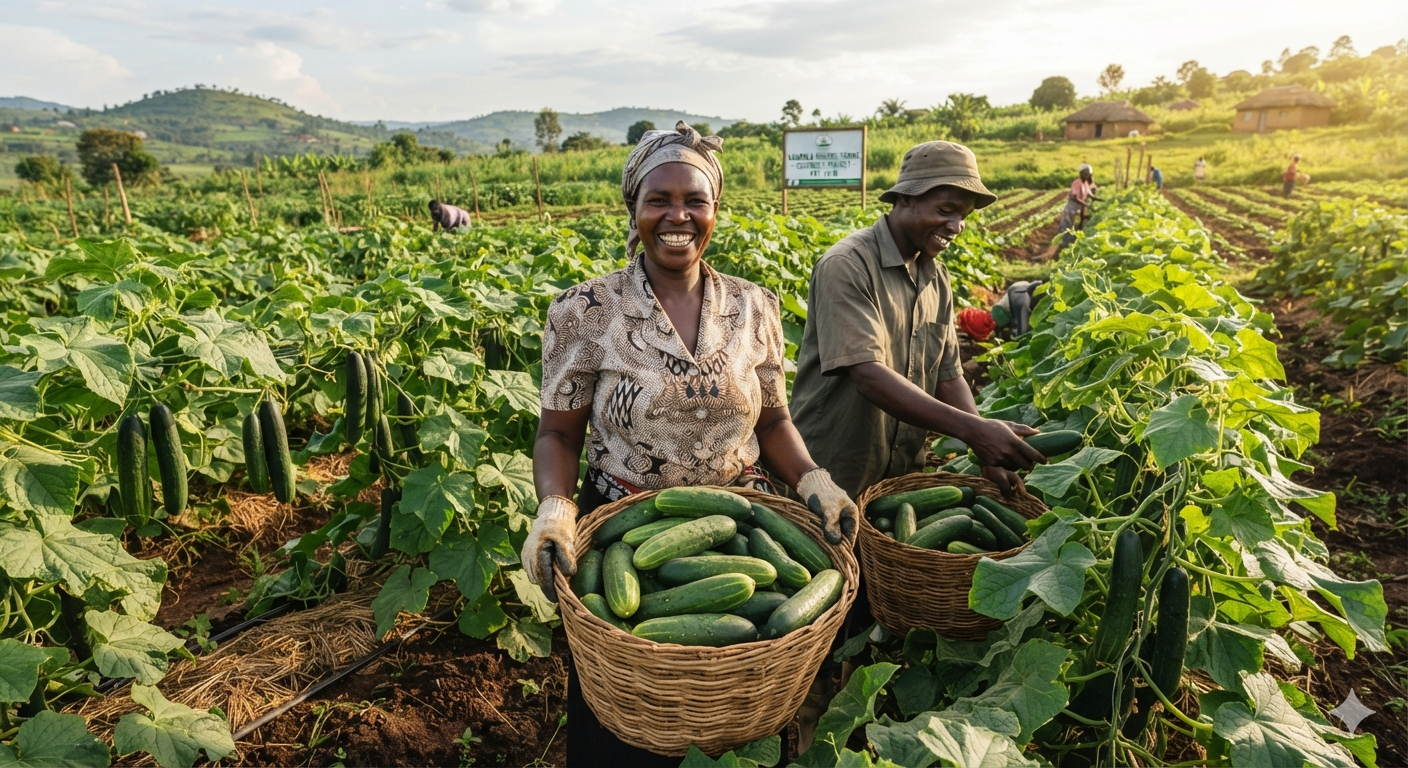
Costs, Yields, Markets & What You Can Realistically Earn — Part 3 of 3
The Question Every Farmer Asks Before They Plant
In Part 1 of this series, we showed you how to grow a strong organic cucumber crop from soil preparation to harvest. In Part 2, we covered how to protect it from the diseases and pests that cause the most damage across Sub-Saharan Africa. Now we answer the question that brings both of those together: is it actually worth doing?
The short answer is yes — organic cucumbers are one of the most profitable short-cycle vegetable crops a farmer can grow in East and West Africa. But profitability is not automatic. It depends on your yield, your input costs, the market you sell into, and how well you manage the crop from seed to sale.
This guide gives you real numbers: realistic yields, what inputs actually cost, what prices you can expect at different markets, and what you can genuinely expect to earn from a quarter acre, half acre, or full acre of organic cucumbers. No hype, no inflated projections — just an honest picture you can plan with.
Why Cucumbers Make Strong Business Sense
Before the numbers, it helps to understand why cucumbers are a smart crop choice for Sub-Saharan African farmers looking to build a profitable vegetable enterprise.
- Short growing cycle: Cucumbers mature in 50–70 days from sowing — meaning you can run 2–3 profitable seasons per year on the same land, compounding your income significantly.
- Strong and consistent demand: Cucumbers are a daily-consumption vegetable sold in every market, supermarket, hotel, and restaurant across Uganda, Kenya, Tanzania, and beyond. Demand is stable year-round.
- Premium for organic: Supermarkets, hotels, health food stores, and export buyers are actively seeking certified organic produce and pay a consistent premium over conventionally grown cucumbers. This premium is your competitive advantage as a POFI customer.
- Low barrier to entry: You do not need large land or heavy machinery to start. A quarter acre is enough to generate meaningful income and learn the crop before scaling up.
- Complementary to other crops: Cucumbers fit neatly into crop rotation plans with tomatoes, beans, and leafy greens — keeping your land productive and your soil healthy year-round.
What Yield Can You Realistically Expect?
Yield is the foundation of any profit calculation. Cucumber yields in Sub-Saharan Africa vary significantly depending on soil quality, water management, pest and disease control, and variety choice. Here are realistic yield benchmarks based on research across the region:
| Management Level | Yield per Acre | Yield per Hectare | Notes |
| Basic — minimal inputs, no irrigation | 3–5 tonnes | 7–12 tonnes | Rainfed, minimal pest control |
| Average — moderate inputs, drip irrigation | 5–8 tonnes | 12–20 tonnes | Good soil prep, basic spray programme |
| Well-managed — organic programme, trellising | 8–12 tonnes | 20–30 tonnes | Full organic input programme, regular scouting |
| Commercial greenhouse / polytunnel | 15–25 tonnes | 37–62 tonnes | Controlled environment, premium market |
For planning purposes, a well-managed organic open-field farm targeting 8–10 tonnes per acre is a realistic and achievable target for farmers following the growing and disease management practices in Parts 1 and 2 of this series.
| ⚠ Watch Out Be cautious of yield projections above 12 tonnes per acre for open-field growing without controlled irrigation and a full disease management programme. These figures are achievable but not typical for first-season farmers. Plan conservatively and let your experience guide scale-up decisions. |
Cucumber Market Prices Across Sub-Saharan Africa
Cucumber prices vary by country, market channel, season, and whether you are selling conventionally grown or organic produce. Here are realistic price ranges based on current market data:
| Market / Country | Farm Gate Price (per kg) | Wholesale Price (per kg) | Retail / Organic Premium (per kg) |
| Uganda (Kampala) | UGX 1,000–2,500 (~$0.27–$0.68) | UGX 2,500–5,000 (~$0.68–$1.37) | UGX 4,000–7,000+ (supermarkets/hotels) |
| Kenya (Nairobi) | KES 30–60 (~$0.23–$0.46) | KES 50–80 (~$0.38–$0.62) | KES 80–150+ (organic/premium retail) |
| Tanzania (Dar es Salaam) | TZS 800–1,500 (~$0.30–$0.58) | TZS 1,500–2,500 (~$0.58–$0.97) | TZS 2,500–4,000+ (premium buyers) |
| Export / Regional | USD 0.80–1.20/kg | USD 1.00–1.50/kg | USD 1.50–2.50+/kg (organic certified) |
Prices fluctuate seasonally — they tend to be highest when rains reduce supply (dry season irrigated production) and lowest at peak rainy season when most farmers are harvesting simultaneously. Timing your planting to harvest during high-price windows is one of the most reliable ways to improve your returns.
What Does It Cost to Grow Organic Cucumbers?
Knowing your costs is as important as knowing your prices. Below is a realistic organic input cost breakdown for one acre of open-field cucumber production in Uganda or Kenya. Costs will vary depending on your specific location and input sources.
| Input / Activity | Estimated Cost (USD) | Notes |
| Certified organic cucumber seeds | $15–$35 | Quality seed is the foundation — never cut corners here |
| Soil preparation (labour + compost/manure) | $40–$80 | Well-prepared soil reduces all other input requirements |
| Organic plant food / fertiliser (e.g. Epso Microtop, Organic Vegetable Plant Food) | $30–$60 | Applied through the growing cycle for steady nutrition |
| Organic pest control (e.g. Insecten Hardnekkig, neem oil, sticky traps) | $20–$45 | Prevention is cheaper than cure — scout early |
| Mulch (grass, rice husks, or plastic mulch) | $10–$25 | Moisture conservation + weed control |
| Staking / trellising materials | $20–$50 | Bamboo poles or string trellis; reusable across seasons |
| Irrigation (drip tape or furrow setup) | $30–$80 | Critical for dry-season production; reusable |
| Labour (land prep, planting, scouting, harvesting) | $60–$120 | Biggest variable cost; depends on farm location |
| Post-harvest handling (crates, transport) | $15–$30 | Often overlooked but critical for price at market |
Total estimated input cost per acre: USD $240–$525, depending on scale and management approach. A well-managed acre budgeted at around $350–$400 is a realistic planning figure for most farmers in Uganda or Kenya growing organically.
Profit Scenarios: What Can You Realistically Earn?
Using the yield and price data above, here are three honest profit scenarios for one acre of organic cucumber production. These use conservative yield assumptions and mid-range market prices — not best-case figures.
| Scenario | Yield (per acre) | Price (per kg) | Gross Revenue | Input Costs | Net Profit |
| Basic — local market, minimal inputs | 4 tonnes (4,000 kg) | $0.27/kg (farm gate) | ~$1,080 | ~$240 | ~$840 |
| Average — wholesale, good management | 8 tonnes (8,000 kg) | $0.45/kg (wholesale) | ~$3,600 | ~$380 | ~$3,220 |
| Well-managed — organic premium buyers | 10 tonnes (10,000 kg) | $0.75/kg (premium) | ~$7,500 | ~$480 | ~$7,020 |
These are per-season figures. With 2–3 seasons per year possible on the same land, even the average scenario compounds to a strong annual income from a single acre — and the premium organic scenario represents a genuinely transformative return for smallholder and commercial farmers alike.
Five Ways to Maximise Your Cucumber Profit
1. Sell Into the Right Market Channel
The single biggest lever on your profit is where you sell, not how much you grow. Selling 8 tonnes at wholesale earns you roughly $3,600. Selling the same 8 tonnes to a premium organic buyer, hotel, or supermarket at $0.75/kg earns you $6,000 — from the same land, same inputs, same labour. Invest time in finding and qualifying premium buyers before you plant your first seed.
2. Time Your Harvest to Hit High-Price Windows
Cucumber prices peak during dry seasons when rainfed supply drops. Farmers who can irrigate and produce during the dry season consistently achieve 30–60% higher prices than wet-season producers. Dry-season production requires more investment in irrigation but the price premium more than compensates.
3. Protect Your Yield — Every Kilogram Lost Is Lost Revenue
If disease or pests cost you 30% of your crop — a common figure for unmanaged fields across the region — that is 2.4 tonnes lost on an 8-tonne field. At $0.45/kg, that is over $1,000 gone in a single season. The organic disease and pest management programme in Part 2 of this series typically costs less than $65 per acre to implement. The return on that $65 is not optional — it is essential.
4. Reduce Post-Harvest Losses
Studies across Sub-Saharan Africa estimate that 20–40% of cucumbers are lost between harvest and market due to poor handling, inadequate storage, and transport damage. Harvesting at the right stage, using proper crates, keeping fruit cool and shaded, and selling quickly after harvest are free or low-cost practices that protect a significant share of your potential income.
5. Run 2–3 Seasons Per Year
One of cucumbers’ greatest strengths as a cash crop is speed. At 50–70 days from seed to first harvest, you can run two full seasons and often a third partial season on the same land each year. Each additional season compounds your income without additional land costs. Plan your rotation and input purchasing in advance so you can move quickly from one season to the next.
The Organic Advantage: Why It Pays to Go Chemical-Free
For farmers across Sub-Saharan Africa, organic certification and organic-first growing practices are no longer just an ethical choice — they are increasingly a commercial one. Here is why:
- Premium market access: Supermarkets, hotels, health stores, and export buyers across East Africa are actively seeking certified organic produce and paying a consistent premium. This market segment is growing faster than conventional vegetable supply.
- Lower long-term input costs: Synthetic pesticide and fertiliser dependency is expensive and escalates over time as pest resistance builds. Organic inputs like neem oil, copper fungicides, compost, and targeted biocontrols often cost less per season once you have the programme established.
- Healthier soil over time: Organic matter, beneficial soil biology, and reduced chemical load improve soil structure and water retention season after season — reducing irrigation costs and improving yields over time without additional input investment.
- Safer for your family: Farmers applying synthetic pesticides face real health risks from repeated exposure. Organic-approved inputs are significantly safer for the farmer, their family, and the community around the farm.
| Start Your Organic Cucumber Business with POFIPure Organic Farming Inputs (POFI) supplies everything you need to build a profitable organic cucumber enterprise: certified Organic Cucumber Seeds, Organic Vegetable Plant Food, Epso Microtop micronutrient fertiliser, and Insecten Hardnekkig for organic pest control. All products ship worldwide from the Netherlands. Contact our team for free growing advice and to place your order at pureorganicfarminginputs.com. |
Frequently Asked Questions
How much does a farmer earn from one acre of cucumbers in Uganda?
A well-managed acre of organically grown cucumbers in Uganda can yield 8–10 tonnes per season. At wholesale prices of around $0.45/kg, that translates to $3,600–4,500 gross revenue per season, with input costs of $350–$450 leaving a net profit of $3,000–4,000 per acre per season. Three seasons per year is achievable with good planning.
Is organic cucumber farming more profitable than conventional?
Yes, in most cases — particularly when selling into premium channels. The organic input cost is broadly comparable to conventional, but the price premium at organic-focused markets, supermarkets, and hotels is typically 30–70% above conventional prices. The key is finding and maintaining access to those buyers.
What is the best market to sell organic cucumbers in East Africa?
Supermarket chains (Carrefour, Naivas, Shoprite), high-end hotels, health food stores, and institutional buyers (hospitals, schools, corporate catering) consistently pay the best prices for certified organic cucumbers. Direct farmer-to-consumer sales at urban farmers’ markets are also growing rapidly across Kampala, Nairobi, and Dar es Salaam.
How many seasons can I grow cucumbers per year?
In most of Sub-Saharan Africa, two full seasons are reliably achievable per year. With irrigation and good planning, a third partial season is possible on the same land. Each additional season significantly improves the annual return per acre without additional land costs.
What is the biggest risk in organic cucumber farming?
Disease and pest losses — particularly downy mildew, bacterial wilt, and fruit fly — are the most common cause of below-target yields and income shortfalls. The organic management programme covered in Part 2 of this series is the most effective insurance against these risks. Starting with quality certified seeds from a trusted supplier is the second most important risk management step.
You Now Have the Full Picture
Part 1 showed you how to grow a strong organic cucumber crop. Part 2 showed you how to protect it. This guide has shown you what it can genuinely earn you. Together, these three guides give you everything you need to plan, grow, manage, and profit from organic cucumbers across Sub-Saharan Africa.
The next step is simple: start with the right seed. Order your Organic Cucumber Seeds, Organic Vegetable Plant Food, Epso Microtop, and Insecten Hardnekkig from Pure Organic Farming Inputs (POFI) — shipping organic farming inputs worldwide from the Netherlands. Contact our team for free growing advice and personalised guidance for your region.
Content prepared by: pureorganicfarminginputs.com
Part 3 of 3: Profit & Business Case Guide. ← Part 1: Complete Growing Guide | Part 2: Disease & Pest Management Guide