
The organic micronutrient fertilizer that works through your leaves, not your soil
The Problem You Can See But Cannot Explain
Samuel grows tomatoes and cucumbers on two acres outside Kampala. His plants look healthy enough at a distance — but up close, the story is different. Leaves are yellowing between the veins. Fruit is setting poorly. Growth has slowed even though he fertilised at planting. He switches to a higher nitrogen product. Nothing changes.
What Samuel is looking at is not a nitrogen deficiency. It is a magnesium and micronutrient deficiency — and no amount of nitrogen will fix it. His soil is providing macronutrients, but the micronutrients that control how plants use those macronutrients are missing. His crops are running an engine without oil.
This is exactly the problem Epso Microtop was designed to solve. And because it is applied directly to the leaf rather than through the soil, it works fast — often visibly within days of the first application.
What Is Epso Microtop?
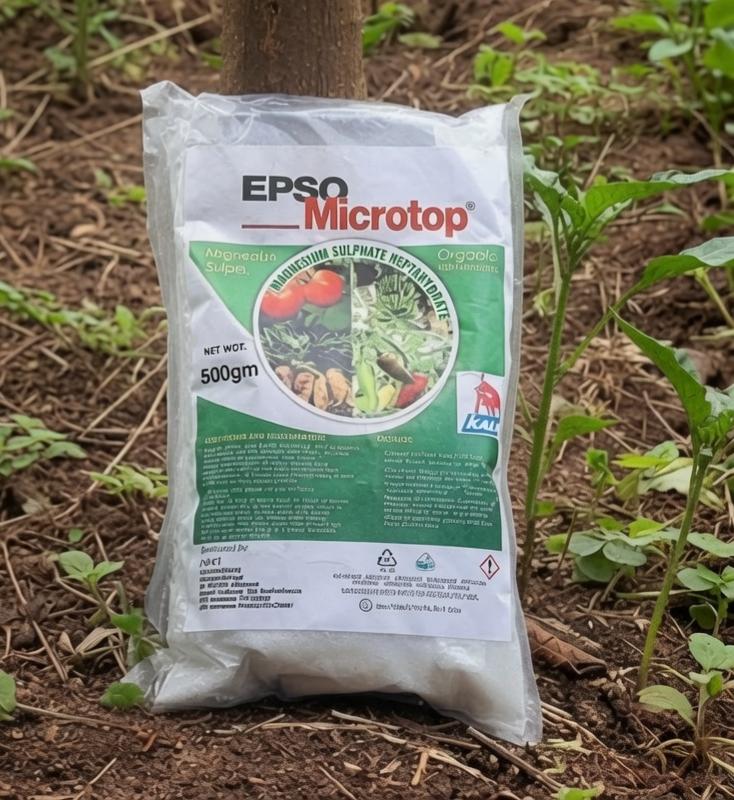
Epso Microtop is an immediately effective foliar fertilizer produced by K+S Minerals and Agriculture — one of Europe’s leading natural mineral fertilizer manufacturers. It is extracted from natural underground crude salt deposits in Germany, formed millions of years ago when ancient seas evaporated. No synthetic manufacturing. No chemical processing. Just natural minerals, refined for agricultural use.
It contains four active nutrients that work together to correct the most common micronutrient deficiencies in vegetable and field crops:
| Nutrient | Content | What It Does for Your Crop |
| Magnesium (Mg) | 9% Mg (15% MgO) | The central atom in chlorophyll — without it, leaves cannot photosynthesise. Also activates over 300 plant enzymes and is essential for transporting nutrients from roots to leaves and fruit. |
| Sulphur (S) | 12.4% S (31% SO₃) | Essential for protein and amino acid synthesis. Increases the efficiency of nitrogen already in the plant — meaning your other fertilisers work better when sulphur levels are adequate. |
| Boron (B) | 0.9% B | Controls the movement of sugars through the plant. Critical for flower formation, pollen viability, and fruit set — low boron is a leading cause of poor fruit development across the region. |
| Manganese (Mn) | 1% Mn | Essential for enzyme activation and early-stage photosynthesis. Deficiency causes interveinal chlorosis (yellowing between veins) — one of the most commonly misdiagnosed nutrient problems in Sub-Saharan Africa. |
| Certified OrganicEpso Microtop is approved for use in organic farming in accordance with EU Regulations 2018/848 and 2021/1165. It contains no synthetic chemicals and is fully compatible with certified organic production systems. |
Why Apply Through the Leaf, Not the Soil?
Most fertilisers are applied to soil and taken up by roots. This works well for major nutrients like nitrogen, phosphorus, and potassium. But micronutrients are a different story.
In many Sub-Saharan African soils — particularly sandy, acidic, or heavily cropped soils — micronutrients like magnesium, boron, and manganese are either naturally low or become locked up by soil pH, competing ions, or over-irrigation. Even when they are present in the soil, plants often cannot access them efficiently.
Foliar application bypasses this problem entirely. When Epso Microtop is sprayed onto leaves, nutrients are absorbed directly through the leaf surface and transported immediately into the plant’s active tissues. The result:
- Speed: Visible response often within 3–5 days, compared to weeks for soil-applied corrections
- Efficiency: Loss-free absorption via the leaf — no nutrient lockup, no leaching, no soil pH interference
- Precision: Applied exactly when the crop needs it most — at flowering, fruit set, or the moment deficiency symptoms appear
- Soil independence: Works regardless of soil pH, moisture level, or competing mineral ions
Which Crops Benefit Most?
Epso Microtop is specially adapted to root and leaf crops, but benefits a wide range of vegetables and field crops grown across Sub-Saharan Africa.
| Crop | Key Benefit |
| Tomatoes | Corrects interveinal yellowing; supports fruit development and colour; boron improves fruit set at flowering |
| Cucumbers | Boron supports flower and fruit formation; magnesium and sulphur maintain deep green, productive leaves through the long fruiting period |
| Peppers & Chillies | Manganese and boron support flowering and fruit set; magnesium improves fruit colour |
| Leafy Greens (kale, spinach, cabbage) | Magnesium and sulphur maintain deep green colour and protein content; sulphur is critical for brassica quality |
| Beans & Legumes | Manganese supports nitrogen fixation by root nodule bacteria; improves biological nitrogen efficiency |
| Maize & Sorghum | Magnesium is critical during grain fill; sulphur improves protein quality |
| Root Crops (carrots, sweet potato) | Boron supports healthy root development; reduces internal splitting and browning |
Signs Your Crop Needs Epso Microtop
Micronutrient deficiencies are frequently misdiagnosed as nitrogen shortage, disease, or drought stress. Look for these specific signals:
- Interveinal chlorosis on older leaves: Yellowing between the veins while veins remain green. Starts on the lowest leaves and progresses upward — the classic sign of magnesium deficiency.
- Poor fruit set despite healthy flowering: Flowers dropping without setting fruit, or very low fruit numbers — often a boron deficiency.
- Pale, slow-growing young leaves: Manganese deficiency causes a patchy, checkerboard interveinal yellowing on young leaves near the main veins — appearing on new growth rather than old leaves. This checkerboard pattern is the key visual difference from magnesium deficiency, which starts on the oldest leaves.
- Slow growth despite adequate watering and nitrogen: Sulphur deficiency limits protein synthesis and reduces how efficiently the plant uses other nutrients.
- Poor fruit colour and quality: Magnesium is essential for chlorophyll and carotenoid synthesis — deficient plants produce pale, uneven, less marketable fruit.
How to Use Epso Microtop: Application Guide
Mixing
- Dissolve Epso Microtop in one-third of your required water volume first, then top up with the remaining water
- Add any other compatible products after the Epso Microtop has dissolved fully
- Stir vigorously — the product is completely water-soluble and leaves virtually no residue
- Always test compatibility with other products in a small volume before preparing a full tank mix
Application Rate
- Standard foliar rate: 5 kg Epso Microtop per 100 litres of water (a 5% solution)
- Field application rate: approximately 25 kg per hectare (10 kg per acre) per application
- One to two applications per season covers maintenance needs; two to three for deficiency correction or high-demand crops
Timing
- Early vegetative stage: Promotes deeper root development and stronger establishment from the start of the season
- Pre-flowering: Apply before flowers open to ensure adequate boron for pollen viability and fruit set — the single most impactful timing for fruiting crops
- Fruit development: A second application during active fruit growth supports quality, colour, and size
- At first deficiency symptoms: Apply immediately — foliar uptake means you will see a response within days
Spray Conditions
- Apply in the cool of the morning or late evening to reduce evaporation and improve leaf absorption
- Avoid spraying in strong midday sun or when rain is expected within 2–3 hours
- Ensure good coverage of the full leaf surface, including undersides
- Use a clean sprayer — residues from previous products can affect solubility and compatibility
Why Organic Farmers Across Sub-Saharan Africa Choose Epso Microtop
- Fully organic certified: Approved under EU organic regulations — safe for certified organic operations worldwide
- Natural origin: Extracted from ancient natural mineral deposits — not synthesised from industrial chemicals
- Works regardless of soil pH: Bypasses nutrient lockup in acidic or alkaline soils that affect large areas of Sub-Saharan Africa
- Multiplies the value of your other inputs: Sulphur improves nitrogen efficiency — the nitrogen fertiliser you already apply delivers more benefit when sulphur is adequate
- Fast-acting: Visible results in days, not weeks — critical during short growing seasons where every week of healthy growth matters
| Order Epso Microtop from POFIPure Organic Farming Inputs (POFI) stocks Epso Microtop and ships worldwide from the Netherlands. Contact our team for free application advice specific to your crop and region, or place your order at pureorganicfarminginputs.com. |
Frequently Asked Questions
Is Epso Microtop safe for organic farming?
Yes. Epso Microtop is approved for organic farming under EU Regulations 2018/848 and 2021/1165. It is extracted from natural mineral deposits and contains no synthetic chemicals.
How quickly will I see results?
Because it is applied directly to the leaf, you can typically see a visible improvement in leaf colour and plant vigour within 3–5 days of the first application — especially when correcting a magnesium or manganese deficiency.
Can I use Epso Microtop on all my vegetable crops?
Yes. It is beneficial for tomatoes, cucumbers, peppers, leafy greens, beans, root vegetables, maize, and more. It is especially valuable for fruiting crops during flowering and fruit development when boron and magnesium demand is highest.
How often should I apply it?
One to two applications per season covers maintenance needs for most vegetable crops. For crops showing deficiency symptoms or during high-yield seasons, two to three applications spaced 2–3 weeks apart give the best results.
What makes Epso Microtop different from a regular magnesium fertiliser?
Standard magnesium products applied to soil are slower and can be blocked by soil pH or competing nutrients. Epso Microtop goes directly to the leaf and is absorbed immediately, regardless of soil conditions. It also combines magnesium with sulphur, boron, and manganese — correcting four potential deficiencies in one spray.
Also growing tomatoes or cucumbers? Epso Microtop features throughout our organic growing guides. Read our complete organic cucumber growing guide and the Simona F1 tomato disease management guide for crop-specific application timing.